

How this began
I did not come to this question through technology. I am a healing-centered peacebuilding practitioner trying to keep up with tech as best I can.
For thirty years I have worked in countries facing instability, conflict, and harm, including Sierra Leone, Liberia, Kenya, Somalia, South Sudan, and Kosovo, most recently with young people who have lived through chronic violence. Those rooms were never short on information or plans. What held was a small set of human capacities. Knowing what is happening inside you before it runs you. Catching yourself in the heat of the moment. Asking what you are bringing into the room, not only what is wrong with them. Hearing what another person is not saying. Staying present under pressure, without disappearing into blame or rescue or silence.
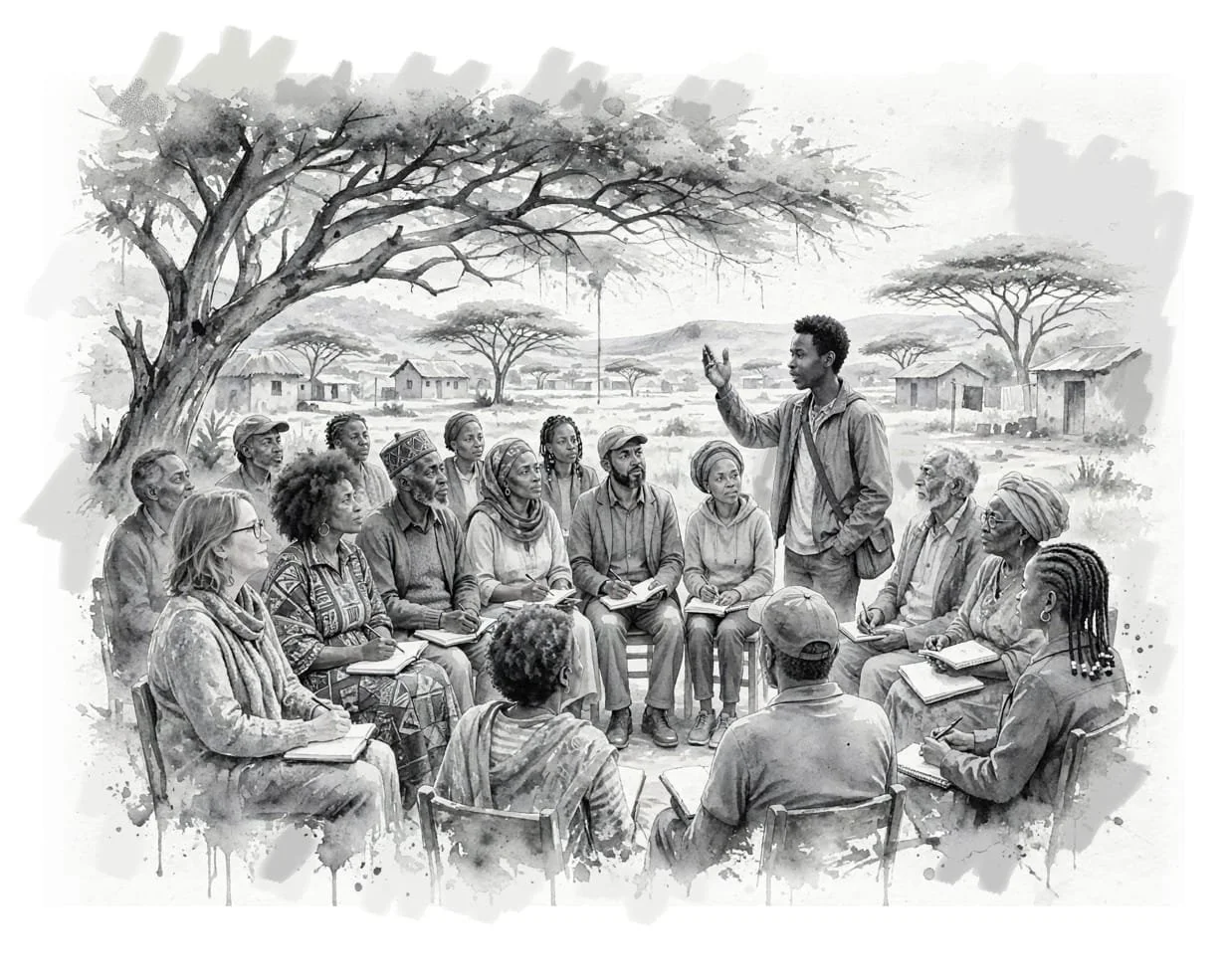
"A Circle Under the Tree." · Radoli, Kenya, 2026 · Black and white watercolor, painted by handNone of that is soft. In those places, these capacities could be the difference between a community that recovered and one that didn't.
AI can now produce most of the visible artifacts of knowledge work. I teach with AI. I use it most days. But watch what happens as we hand more of our work over. We delegate the drafting, then the thinking that drafting used to force. Each handoff is individually reasonable. Nobody decides to disappear.
Yet AI needs us more than ever. It can summarize a meeting, but it can't notice who went quiet. What makes AI useful is what only people can give it.
There is a quieter risk too. With a machine that never tires, never disagrees, and never needs anything from us, it becomes easy to stop needing each other. Thirty years of this work taught me that people heal, rebuild, and do their best work in relationship. Organizations that use AI to replace human contact will lose something they can't measure until it's gone. Those that use it to free people for deeper connection will be stronger for it.
What Stays Human is my answer — the five capacities I watched hold people together, the evidence behind each one, and practices to build them.
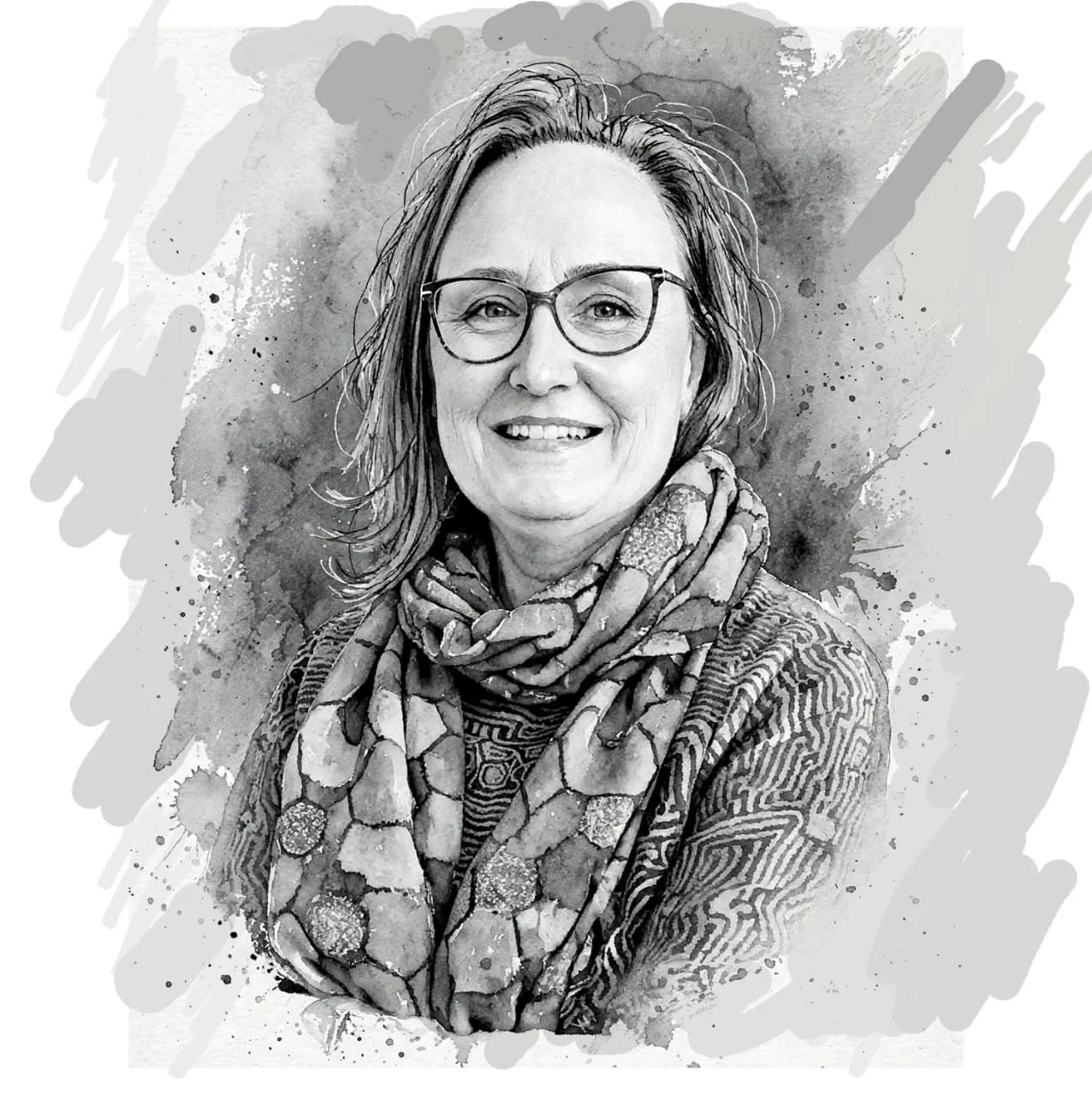
"The Part That Requires a Self." · Radoli, Kenya, 2026 · Black and white watercolor, painted by handAbout me
I'm Angi Yoder-Maina. For more than three decades, I have been teaching and facilitating with communities, organizations, and classrooms. I teach design thinking at Florida State University, and previously directed FSU's Resilience Institute for Strength and Empowerment (RISE). I founded Green String Network, which does healing-centered peacebuilding work in East Africa, and my framework for that work is published in Healing is What Makes Peace Work (Springer, 2022). I hold a doctorate in Applied Conflict Transformation from Paññāsāstra University of Cambodia.
Everything I've learned points to one thing. People are held together by a few human capacities, and those capacities are exactly what's at risk as AI takes over more of our work. What Stays Human is how I'm bringing that work to the people and teams living through this change.
I live between Tallahassee and Nairobi, Kenya.
How I use AI
I'm Gen X, a lifelong peacebuilding practitioner who became an academic later in life, and for a while I was anxious about falling behind on AI. The more I tried to keep up, the worse it got. I kept finding AI slop and digital products that promised to fix the feeling if I bought something. None of them helped the anxiety.
What helped was what peacebuilders do when things are unsettled. I made an agreement. I sat down and wrote my own AI Working Agreement, the same one you'll find on this site. The anxiety wasn't really about knowing every tool. It was about never having chosen how I use them.
This is what mine says.
I hand AI routine email and the production side of design, the layouts, the slides, the formatting. That leaves me more room for listening, for testing ideas, and for the judgment about which ones become real work.
I never hand over the thinking in anything relational. For those messages I write my own bullets first, what I noticed, what I want the person to know, and what I'm asking. AI can help with the shape afterward, not instead.
When my daughters send me something, AI is off. I read every word myself, because reading it is the listening.
Nothing with a number, a quote, or a name goes out under my name until I have seen the source myself. AI can point me to what needs to be checked. The checking is mine.
And I say how AI helped. Squarespace's Blueprint AI created the starting layout. Claude, made by Anthropic, helped me shape the wording, write the code for the agreement tool, and produce the graphics. The ideas, the stories, and the decisions are mine.
I'm also building several paid tools. I made the free tool first, the one I wish I had found when I was anxious. Nothing I make here promises to fix the feeling of being overwhelmed, because the moment we are in is a generational shift. What I can offer are simple tools you can actually use, each one a practice, and each one honest about what it can't do.
The name at the bottom of my agreement is my own. I revisit it every ninety days, because things are changing fast. I am still learning, and so are the tools.
About the paintings. The watercolors on this site are painted by hand by Radoli, a Kenyan artist I have worked with since 2016. At Green String Network, we chose watercolor on purpose, and the artists painted from the stories people told in our workshops. While I built this site, I used AI-generated placeholders. They looked fine, but they weren't anyone's. What Stays Human is about the part of our work that needs a person to be present, and a watercolor is a record of someone being present. Every line is a choice, and every place the water ran is a moment no one could fully plan. If you'd like to work with Radoli or other Kenyan artists, I'm happy to introduce you.