

Emotional Literacy, the first of the five capacities. Why I use the term emotional literacy, what the research says, and one practice to engage with this week.
This newsletter asks what is ours when AI can do the work.” to “This newsletter asks what stays human as AI takes on more of our workload. This edition starts where the answer starts, inside you.
Every class I teach opens with the same question. How are you arriving today, above the line or below it? (The line is the subject of the next edition.) The first answers are almost always the same. Fine. Busy. Tired. Stressed. Then someone slows down and says dreading, or relieved, and the small group they are sharing with notices the difference.
The first answer is rarely the precise one.
I've worked with people who speak many languages, and usually we do the work in English. When we ask about feelings only in English, the answers can sound forced, and I hear the lack of precision. When our work moves into people's mother tongues, I can see the shift on their faces and in their bodies. People understand and express so much more in their own language. We talk about how we heal in our mother tongue, the way we dream in it. “Fine” and “good” are the easy answers in any language. Some of us never learned how to express the precise word. For others, it lives in a language we aren’t speaking.
One foundation, two directions
What Stays Human is built on five capacities I've watched hold up under pressure, first in places facing conflict and harm, and now alongside AI. Each one comes with a question. Emotional Literacy asks what is happening inside me. Self-Location asks whether I'm open or closed right now. Mirror Work is reflective and asks what perspective I'm bringing in. Empathic Listening asks whether I'm truly hearing others, understanding and believing an experience that differs from mine while staying whole myself. Team Presence asks what we're creating together.
Self-Location and Mirror Work turn inward. Empathic Listening and Team Presence turn outward. Emotional Literacy sits underneath all four. You can't locate yourself without words for what you feel, and you can't hear what someone isn't saying without the same words aimed outward. That's why we start here.
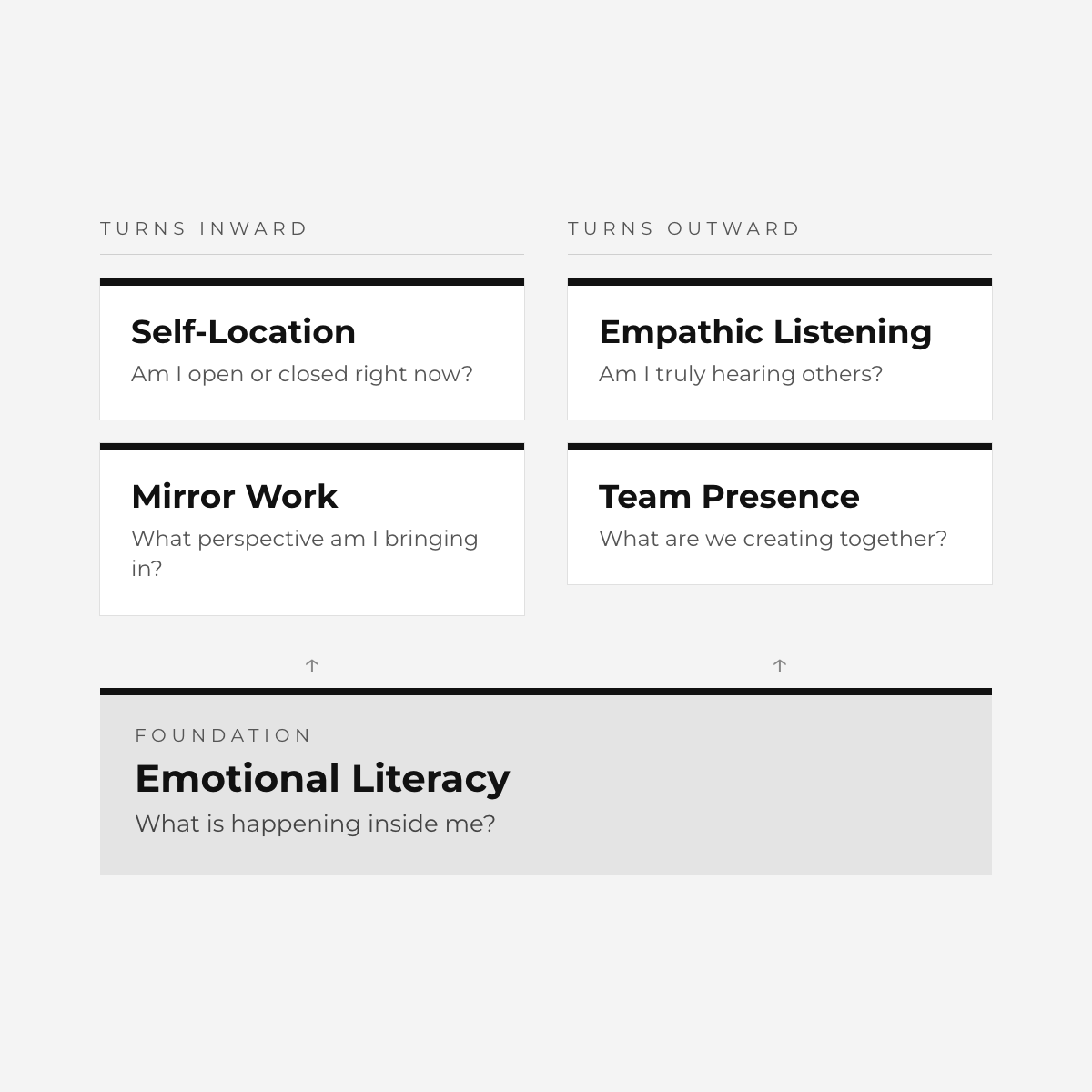
Emotional Literacy is the foundation. Two capacities turn inward, and two turn outward.
Why I use emotional literacy
Most of us know the phrase emotional intelligence. Peter Salovey and John Mayer introduced it in a scientific paper in 1990. Daniel Goleman's bestseller took it mainstream in 1995, the year it made the cover of Time, and it has shaped hiring, leadership development and workplace training ever since.
But the word intelligence suggests something you have a fixed amount of. If naming your feelings is hard, you might decide you're just low on it. Literacy is something you learn and practice. Claude Steiner, who popularized the term, held that emotional literacy isn't inborn and can grow across a lifetime.
That difference matters more now. AI can already sound emotionally intelligent. It can write the warm reply and name the feeling in your message. What it can't do is practice for you. Truly, naming what you feel gets built by doing it, over and over, in the moments when it's hard. If a tool does the naming, you skip the repetitions that build the capacity.
Why the precise word helps
Several lines of research point the same way.
Lisa Feldman Barrett calls it emotional granularity, telling irritated from furious from disappointed instead of filing it all under "bad." People with finer granularity tend to regulate their emotions better, cope better, and report better health.
Matthew Lieberman's lab at UCLA found a mechanism that fits. In brain imaging studies, putting a feeling into words reduced activity in the amygdala, a region tied to stress and fear. Naming a feeling seems to take some of the heat out of it.
Brené Brown approached it from another angle. Her team surveyed thousands of people over five years. On average, people could name only three emotions while they were feeling them. Anger, sadness and happiness. Her book Atlas of the Heart maps 87, and her argument is that the right word gives us understanding and choice.
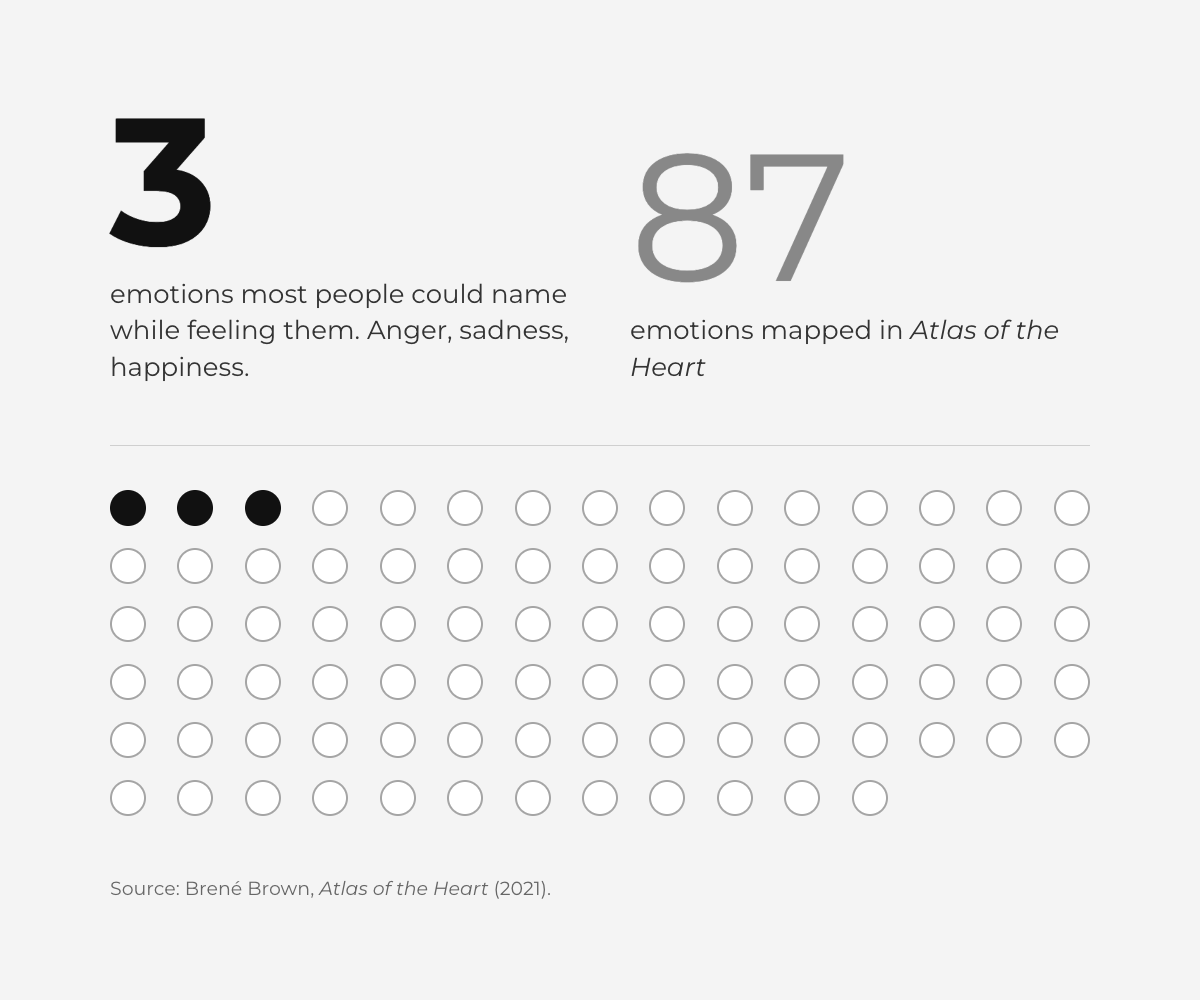
Most of us can name three. Brené Brown’s Atlas of the Heart maps 87.
Adam Grant adds a warning worth keeping. Writing in The Atlantic in 2014, he pointed out that people who sharpen their emotional skills can also get better at manipulating others. Naming feelings is a tool, and tools need a purpose. Emotional Literacy is the foundation the other four capacities stand on, and they give it that purpose.
Where AI comes in
AI can label the emotion in your writing, and it does it well, at least in English. In 2023, researchers gave ChatGPT a standard test of emotional awareness in English, and it scored above human norms. This year, a series of studies led by the University of Manchester, with 1,233 people, found that AI-written emotional support matched what people wrote and sometimes even did better. What AI can't know is what your body is doing in the two seconds between a trigger and your reply.
Language is where this gets personal for me. Most AI has been built in English. Kate Kallot, who founded the Nairobi-based AI company Amini, told the BBC that Africa has been extracted at two levels. Young computer scientists are left labeling data at the bottom of the value chain, and African data trains these systems for free. In a Nation column, Wanjira Mathai wrote that Kallot insists a young African should be able to ask a machine about her own history, language or land and get an accurate answer. I think about what that means for feelings. If the precise word for a feeling lives in our mother tongue, a tool that works mostly in English meets many people only at the surface. They're always translating what they actually feel, and never really saying it.
Research on what this does to us is still early. A four-week randomized trial by MIT Media Lab and OpenAI, with 981 people, found that heavier daily chatbot use went with more loneliness, more emotional dependence, and less time with other people. The authors report a link, not a cause. Nobody has yet tested the question this edition raises, whether letting AI name your feelings weakens your own expression and understanding. The closest clue comes from the other direction. Early research suggests that rating your own emotions, again and again, may sharpen granularity. Doing the naming yourself seems to build the capacity. My worry is that handing it off skips the building.
Many of us reach for AI when we're tired, anxious, or avoiding a hard conversation or an important task. Naming it first tells you whether you're reaching out of purpose or avoidance.
How strong is the evidence?
Emotional Literacy stands on strong ground, with caveats. Most of the granularity evidence is correlational. People with finer granularity do better, but proof that teaching it brings those benefits is still emerging.
The strongest test so far comes from schools. Marc Brackett's RULER program teaches children and teachers to recognize and name emotions. In a randomized trial of 62 schools, classrooms using it showed more warmth and connection after two years. Those were whole-school programs running for years, so they say little about adults at work.
It's also why I avoid the phrase emotional intelligence. The best-known ability test has drawn criticism for what it actually measures, and self-report versions let people answer the way they think they should. Emotions matter at work. The measured construct is shakier than its popularity suggests.
On a team
On a team, the words people have set what can be said. A team with only "fine" and "stressed" has the same conversation every week, and the real one happens in the hallway, or not at all.
Brené Brown sometimes opens meetings with a two-word check-in. Everyone, including her, names how they're feeling in two words. One co-CEO once answered "duct tape" and "glitter," and Brown understood. Holding it together, barely. If someone says “anxious” or “overwhelmed,” Brown checks in with them after the meeting.
Try it the next time your team is about to hand a project to AI. Go around the room first. "Rushed" might mean you're about to hand over the thinking along with the typing. "Unsure" might mean you want the tool to make a call nobody wants to own. "Relieved" might be just fine. Once the words are out, the team can decide together how AI can help and what stays with the team members. Otherwise, the deadline decides.
What comes every two weeks
One capacity, what the evidence says about it, and one thing to practice. One capacity, what the evidence says about it, and one thing to practice. Next time is Self-Location. Once you can name what you feel, the next question is where that puts you — open or closed — and what fear has to do with it.
One thing to try this week
One capacity, what the evidence says about it, and one thing to practice. The next edition is Self-Location, where you are when you reach for AI, and why the line is fear.
Three times this week, stop and ask yourself how you're arriving. When you start work, before a hard conversation, and at the end of the day.
First, name it. If all you find is "fine" or "busy," start with four words we use at Green String Network, the peacebuilding organization I founded. Mad, sad, glad, afraid. Then get more precise. Afraid might be worry, or dread. If you land on mad, look underneath it. Anger usually sits on top of fear or sadness, and it's telling you something needs to change.
Then find it in your body. A tight jaw, a knot in your stomach, shoulders creeping toward your ears. Many of us carry hurts we've never named in our backs and necks. You don't have to fix anything. Naming it and finding it is the practice.
Once, try it right before you open an AI tool. Name what you feel, notice where it sits in your body, and ask what that feeling wants from the tool. Worry wants certainty. Overwhelm wants the task gone. Loneliness wants company.
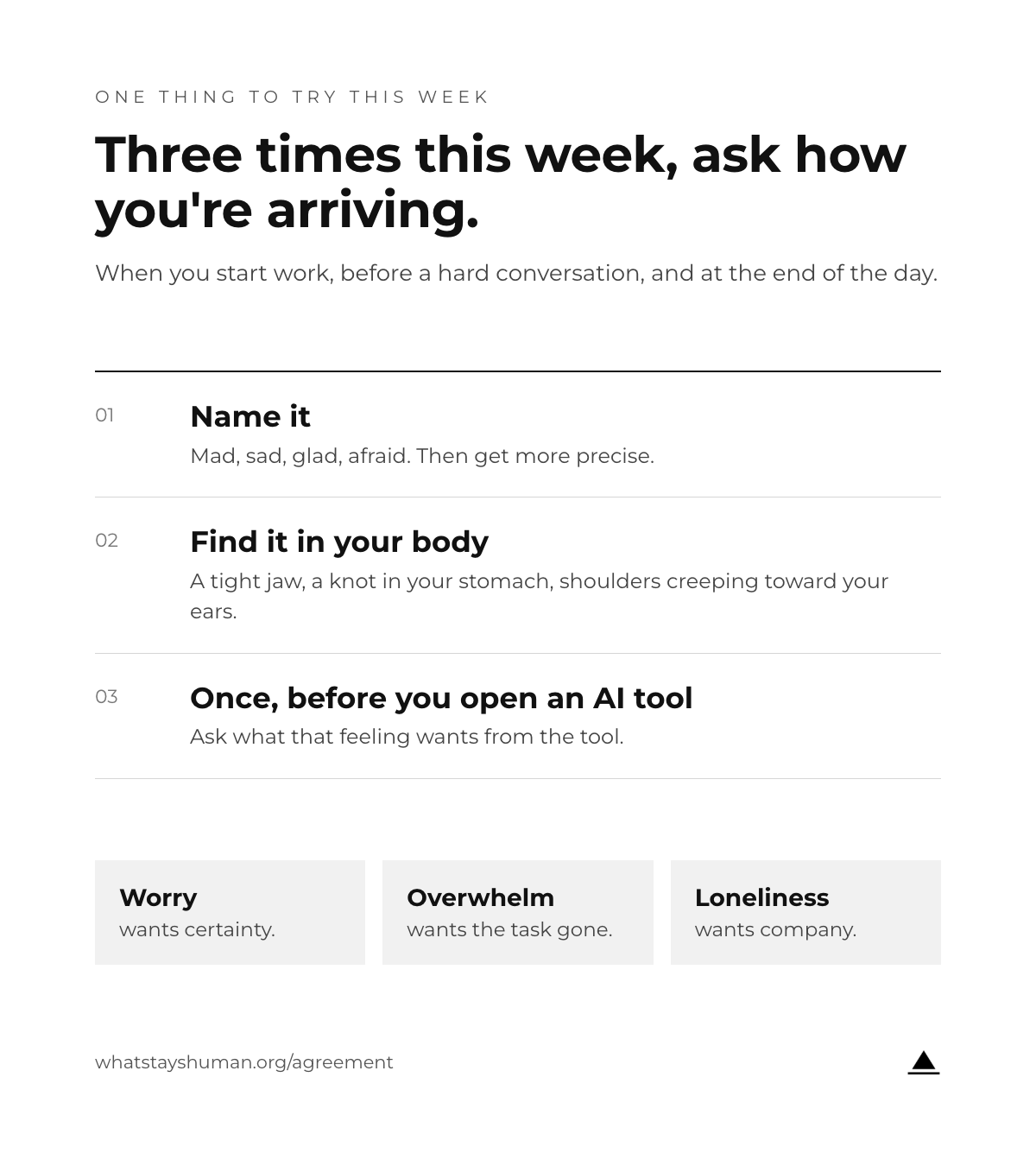
This week’s practice. Save it, or keep it where you’ll see it.
The AI Working Agreement can help you decide ahead of time when AI is off. Make your agreement.
The first answer is rarely the precise one. Keep going. And go gently with whatever word you find.
Angi
sds
Sources
Barrett, L. F., Gross, J., Christensen, T. C., & Benvenuto, M. (2001). Knowing what you're feeling and knowing what to do about it. Cognition and Emotion, 15(6), 713–724.
BBC World Service. (2026). Kate Kallot, AI founder, a global digital divide? The Interview.
Brackett, M. A., Rivers, S. E., Reyes, M. R., & Salovey, P. (2012). Enhancing academic performance and social and emotional competence with the RULER feeling words curriculum. Learning and Individual Differences, 22(2), 218–224.
Brown, B. (2021). Atlas of the heart. Random House.
Chen, Y., Walker, S. A., & López-Pérez, B. (2026). A digital shoulder to cry on: Understanding why large language models can be effective in extrinsic interpersonal emotion regulation. Emotion. Advance online publication. https://doi.org/10.1037/emo0001712
Day, A. L., & Carroll, S. A. (2008). Faking emotional intelligence (EI). Journal of Organizational Behavior, 29(6), 761–784.
Elyoseph, Z., Hadar-Shoval, D., Asraf, K., & Lvovsky, M. (2023). ChatGPT outperforms humans in emotional awareness evaluations. Frontiers in Psychology, 14.
Fang, C. M., et al. (2025). How AI and human behaviors shape psychosocial effects of extended chatbot use. MIT Media Lab and OpenAI.
Grant, A. (2014, January). The dark side of emotional intelligence. The Atlantic.
Kashdan, T. B., Barrett, L. F., & McKnight, P. E. (2015). Unpacking emotion differentiation. Current Directions in Psychological Science, 24(1), 10–16.
Koller, A. (2024, July 29). Bestselling author Brené Brown shares the 2-word exercise she uses to start meetings. CNBC Make It.
Lieberman, M. D., Eisenberger, N. I., Crockett, M. J., Tom, S. M., Pfeifer, J. H., & Way, B. M. (2007). Putting feelings into words. Psychological Science, 18(5), 421–428.
Mathai, W. (2026, July 18). Africa must own its digital future. Nation Africa.
Rivers, S. E., Brackett, M. A., Reyes, M. R., Elbertson, N. A., & Salovey, P. (2013). Improving the social and emotional climate of classrooms. Prevention Science, 14(1), 77–87.
Steiner, C. (1997). Achieving emotional literacy. Bloomsbury.
Torre, J. B., & Lieberman, M. D. (2018). Putting feelings into words. Emotion Review, 10(2), 116–124.
Widdershoven, R. L. A., et al. (2019). Effect of self-monitoring through experience sampling on emotion differentiation in depression. Journal of Affective Disorders, 244, 71–77.
The stories and the decisions are mine. Claude by Anthropic helped shape the words and pointed me to some of the research, which I read before publishing.
