

Why this newsletter exists, what it will do every two weeks, and one practice to try this week. Each edition also comes as a printable PDF.
I teach with AI. I use it most days. I'm not here to cheer it on or to warn you off it. The real question is whether the way we use it makes us better at being human, or slowly worse at it.
I'm writing this because of something I keep noticing in my own work, in my classrooms, and in the teams I support. The handoffs are small, and each one makes sense in the moment. We hand over the first draft, and then the thinking the draft used to force. We hand over the summary, and then the reading. We hand over the first version of the difficult email and, eventually, the difficult conversation.
Nobody decides to disappear. It happens one reasonable handoff at a time.
AI cheapens the artifact
For most of the history of knowledge work, the visible output was the evidence that someone had thought. The memo, the deck, the report. Now a system can produce any of them in seconds.
That doesn't make thinking less important. It moves the value to the parts you can't see. That means judgment about what to trust, clarity about what you're actually trying to do, and the relational work of getting people to tell each other the truth.
Some early research makes this concrete. In a field experiment with nearly a thousand high school math students, Hamsa Bastani and colleagues (2025) gave some students an AI tutor that worked like ordinary ChatGPT. Their scores rose while they had it. When it was taken away, they did worse than students who had never used AI at all. A second group used a tutor running on the same AI, designed to provide hints rather than answers, including hints for common mistakes. Those students largely avoided the drop when AI was removed. The technology was identical. What differed was whether it did the thinking for the students or if it aided them in thinking for themselves.
The part that requires a self
So what is ours? The part that requires a self.
For thirty years I have worked in places facing instability, conflict, and harm. Those environments were never short on analysis. There were reports, assessments, frameworks, and experts who had seen it all before. What they were short on was something no report could supply. They needed people who could stay present with each other when the stakes were high and trust was gone, and who could build connection and safety amid chaos.
When everything else fell away, what held was a small set of human capacities. Knowing what was happening inside you before it controlled you. Catching yourself before fear turned into blame. Asking what you were bringing into the room, not only what others had done. Hearing what someone couldn't say out loud. Making it safe enough for people to tell the truth.
Much of this wasn't new. The communities I worked with carried it in Indigenous wisdom and knowledge, in ways of gathering, listening, and repairing harm that were practiced for generations before anyone wrote a framework about them. That's why it held under pressure. It wasn't something people had read or learned. It was something they had lived, together, for a very long time.
An office is not a conflict zone, and I won't pretend it is. But the patterns I witnessed in high-pressure places are showing up again with AI. When information and output become abundant, what is scarce is the human work around them. In those spaces, the missing piece was never the plan. It was people with the quiet capacity to carry it out together. AI is making plans, drafts, and analyses abundant everywhere. What it can't supply is what those communities couldn't bring in from outside. It can't supply people who can stay open under pressure, hear each other, and decide together what matters.
I've named five. They aren't on the list because today's AI is bad at them. AI will keep getting better at the visible work. But these five aren't visible. Each one needs a person to be present. Without them, AI doesn't fail loudly. It amplifies whatever we bring to it, including our rush, our blind spots, and our avoidance.
And AI needs them. The tutor study showed it. The same AI helped some students and set others back, depending on how the people around it used it. AI works inside the question you ask, the story you give it, the output you decide to trust, and the team that has to act on what it produces. Each of those is a human moment, and each capacity is what makes that moment go well.
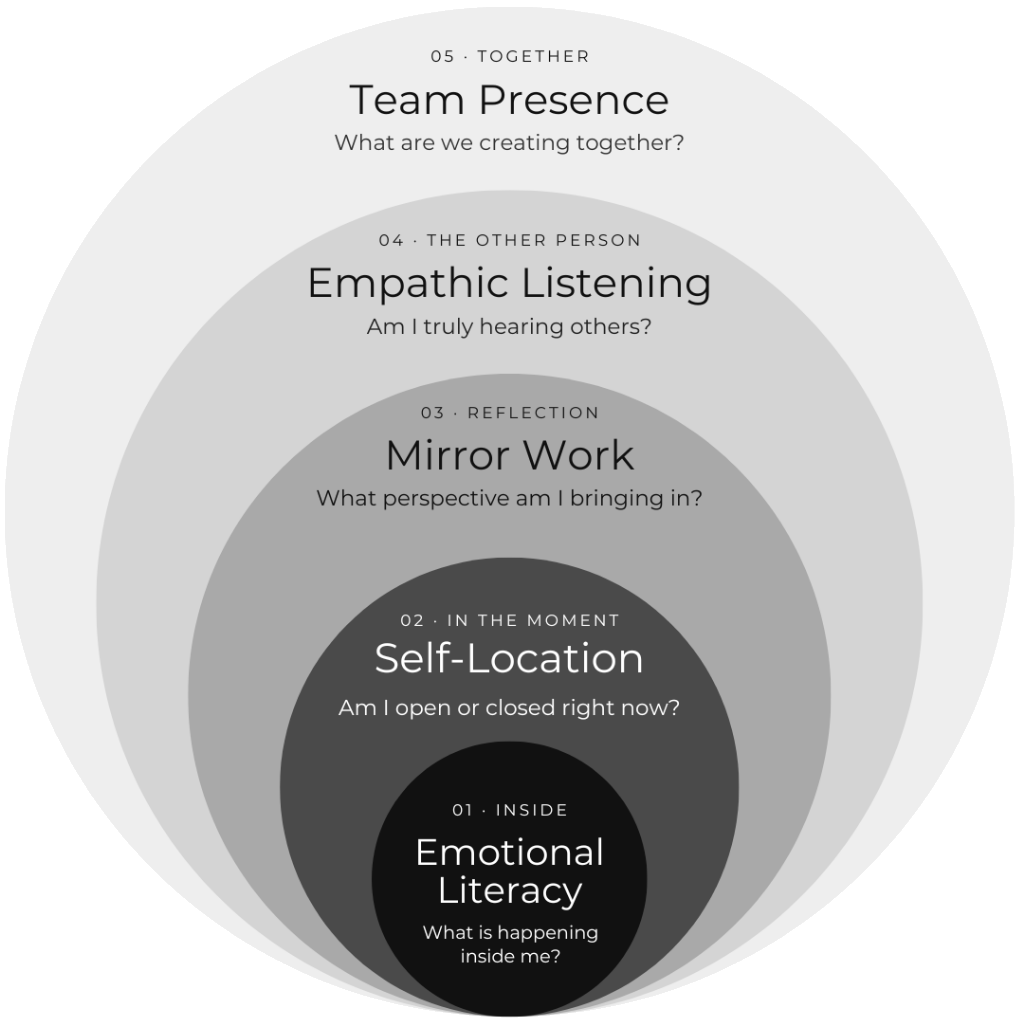
The five capacities that AI can’t do without
01 Emotional Literacy. What is happening inside me? So you know whether you're reaching for AI out of purpose or out of avoidance.
02 Self-Location. Am I open or closed right now? Because handing work to AI when you're defensive or depleted isn't a choice. It's drift.
03 Mirror Work. What perspective am I bringing in? Because AI builds on the story you give it, blind spots included.
04 Empathic Listening. Am I truly hearing others? Because AI summarizes what was said, not what was meant.
05 Team Presence. What are we creating together? Because someone has to feel safe enough to say, "AI got this wrong."
It starts inside you and moves outward, from what you feel and how you're showing up, to what you bring, who's in front of you, and the team around you. Each one widens the circle.
With the limitations printed on the label
The five don't stand on the same ground, and I won't pretend they do. Empathic Listening and Team Presence rest on decades of experiments. Emotional Literacy has strong correlational research and a well-tested school program behind it. Mirror Work comes from a long tradition of reflective practice. Self-Location is a practice framework backed by related research rather than by its own trials. The next few editions will explore each of these capacities in depth, including what the evidence shows.
I also won't promise these five will protect your job. Nobody can promise that. And I won't sell you prompts because prompts are abundant. What I can tell you is that the people who do best alongside these tools, in my classroom and in every room I've watched, aren't the fastest adopters or the loudest refusers. They're the people who know, precisely, what they will hand over and what they won't.
It's all happening so fast that it can feel like there's no time to stop and think. I've spent my working life learning what holds when things move fast, first in places facing conflict and harm, and now in my classroom, where every semester I watch how these tools affect my students' learning in this time of unprecedented transition. This newsletter is my way of making time to think. I hope you'll take that time with me.
What comes every two weeks
For the next few months, this newsletter will take the five capacities one at a time. Each edition looks at how AI is changing the moments when that capacity matters, what the evidence says, and one thing you can practice to strengthen it. The next edition explores Emotional Literacy, the capacity to notice what you are feeling and name it authentically.
One thing to try this week
Make your AI Working Agreement. It takes twenty minutes to decide what you delegate, what you keep, when AI is off, how you verify, how you credit, and who remains responsible. Nothing you type leaves your browser.
Want to work through the AI Working Agreement with me? I offer 45-minute sessions online for individuals or small teams.
Angi Yoder-Maina, PhD
Healing-centered peacebuilder and educator, writing about the human capacities AI can't do without.
Claude (Anthropic) helped me shape the words and the design of this edition. The ideas, the stories, and the decisions are mine.
Source: Bastani, H., Bastani, O., Sungu, A., Ge, H., Kabakcı, Ö., & Mariman, R. (2025). Generative AI without guardrails can harm learning: Evidence from high school mathematics. PNAS, 122(26), e2422633122. https://doi.org/10.1073/pnas.2422633122
